Elements of the Sun
One may often ponder how the Earth came about, but it is rare that they question the origin of the general solar system. It only makes sense that our universe started with the formation of the Sun, as it is the star all of our planets revolve around. The Sun started out as all stars do: scattered specks of dust. Matter builds up in space until their gravitational forces collapse on themselves, creating a protostar, which is, essentially, a baby star. At first, the hydrogen and helium very calmly float around inside the star before the pressure greatens enough to create the more pressurized hydrogen gas that we have in the Sun today. This is what leaves the temperature so high. A common misconception of the Sun is its size. The Sun is actually a very average size, which, ironically, is a characteristic declaring its uniqueness. Part of the reason our planets chose the Sun to be their star is because it is neither too large nor too small. (Redd N. T., 2013)
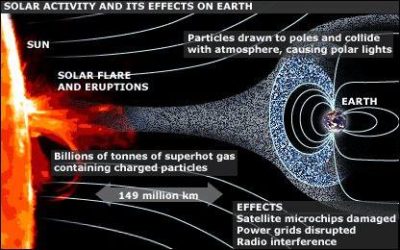
Something many people know about are sun are its solar flares. The definition of a solar flare is a rapid variation in brightness on a sun/star, but that definition doesn’t encompass the true power of our sun’s solar flares. But what really is a solar flare, and how do they happen? (Holmon, http://hesperia.gsfc.nasa.gov/sftheory/toc.htm)
A solar flare occurs when built up magnetic energy is suddenly released. After a solar flare occurs, a whole ton of radiation is also emitted along with electrons, protons, nuclei, and sun “stuff” or a splurge or blast of actual sun. These flares happen in 3 steps: The first step is the precursor. This is when the release of the built up magnetic energy is sparked. Then comes the impulsive stage. This is when the protons and electrons are accelerated through the sun’s atmosphere at 1 million electron volts or 1 MeV. The last stage of a solar flare is the decay stage. This is when there is a build up of decay and x-rays. This can last anywhere from a second to an hour. Also, these solar flares penetrate the outermost layer of the sun called the corona. (Holmon, http://hesperia.gsfc.nasa.gov/sftheory/toc.htm)
The corona is the very outermost layer of our sun, and also is the HOTTEST part of the sun. Yes, you heard correctly! With all of this gas and heat, one can never imagine the power and released energy during a solar flare. To give some perspective, a solar flares releases energy that is 10 million times greater than the energy released during a volcanic explosion. (Holmon, http://hesperia.gsfc.nasa.gov/sftheory/toc.htm)
Finally, solar flares occur in cycles. It takes eleven years for the sun to go through one cycle. It starts with barely any flares, as the years go on, more and more flares occur until it reaches its maximum point, which last happened in about 2011. There is so much to learn about the sun, but how can one fathom its power? By comparison. (Holmon, http://hesperia.gsfc.nasa.gov/sftheory/toc.htm)
There’s a lot more to the Sun than only its solar flares. Did you know that if we were to stuff the sun full of earths, it could hold a staggering 1.3 million earths! The Sun is over 333,000 times the size of earth, which makes it contain 99.85 of all the mass in the solar system. The Sun contains 70% hydrogen and 28% helium. Each second the sun loses 5 million tons of material! It takes an unbelievable 50 million years for energy in the center of the sun to reach the surface. Every second 700 million tons of hydrogen is converted into 695 million tons of helium. You could line up 109 earths on the face of the sun, the diameter of the sun is 864,000 miles. The circumference of the sun is 2,713,406 miles. Every 11 years the magnetic poles of the sun switch, this is called a “Solarmax”. (http://www.goldenkstar.com/facts/sun-interesting-facts.htm)
References:
Redd, N. T. (2013, January 17). How was the Sun formed? Retrieved September 12, 2014, from Space.Com website: http://www.space.com/19321-sun-formation.html
How big is the Sun. (n.d.). Retrieved September 12, 2014, from http://www.space.com/17001-how-big-is-the-sun-size-of-the-sun.html
Interesting facts about the Sun. (n.d.). Retrieved September 18, 2014, from http://www.goldenkstar.com/facts/sun-interesting-facts.html
[Solar flare]. (n.d.). Retrieved from http://scostep.apps01.yorku.ca/wp-content/uploads/2011/10/solar_sun_1653022c.jpg
[Solar Flare]. (n.d.). Retrieved from http://www.offthegridnews.com/wp-content/uploads/2013/07/solar-flares-400x250.jpg
|
The Sun. (n.d.). Retrieved September 12, 2014,
Interesting facts about the Sun. (n.d.). Retrieved September 18, 2014, from
What is a solar flare? (n.d.). Retrieved from NASA website:
How big is the Sun. (n.d.). Retrieved September 12, 2014, from


No comments:
Post a Comment